
AI is one of the most talked-about business opportunities right now. Leaders are asking how it can save time, reduce manual tasks, improve communication, and help teams get more done.
Those are the right questions to ask.
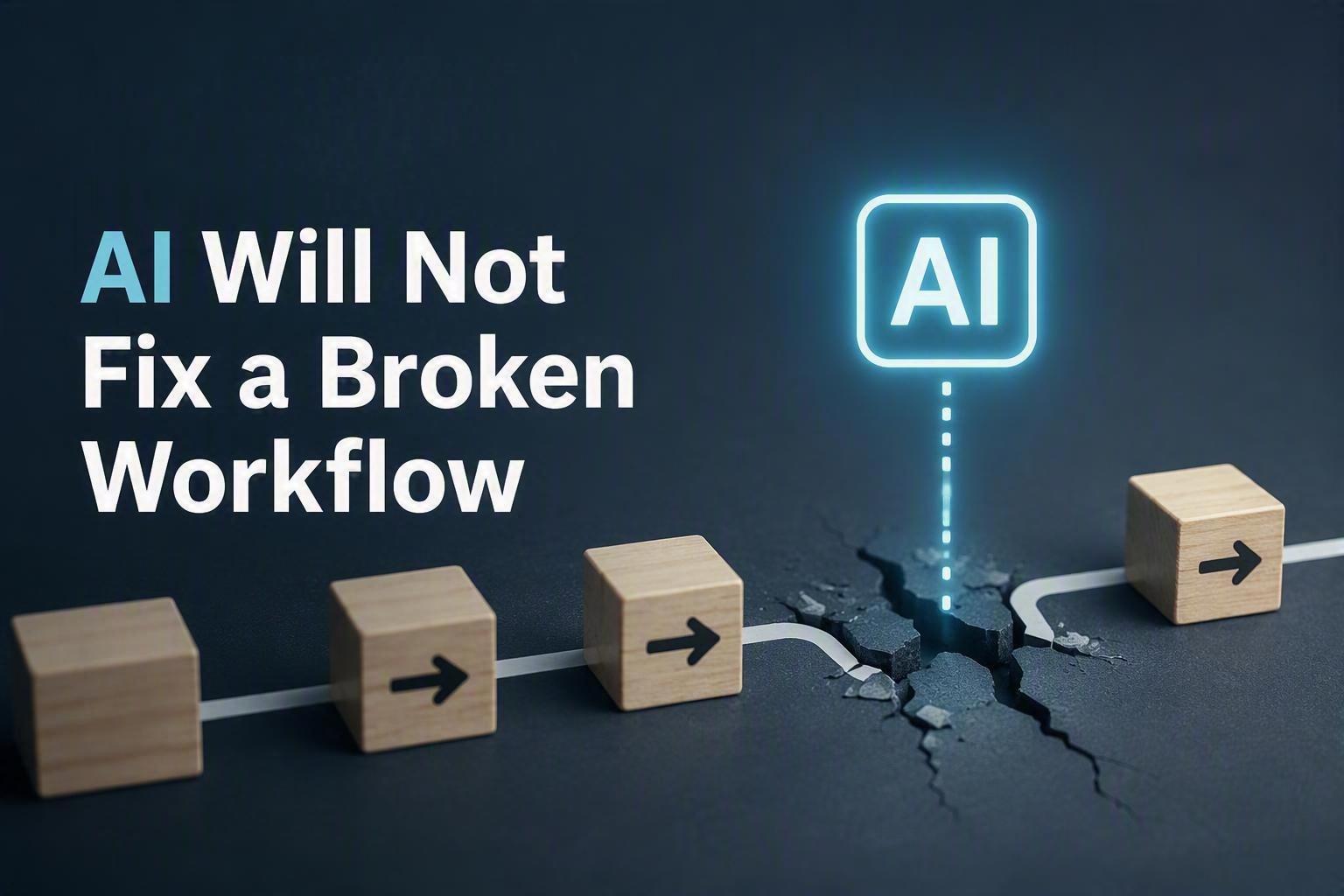
But there is one problem many companies overlook: AI will not fix a broken workflow.
If a process is unclear, inconsistent, or overly manual, AI may not solve the issue. It may simply speed up the confusion.
For CEOs, COOs, and CFOs, this matters because productivity problems often look smaller than they really are. A few extra clicks. A spreadsheet that has to be updated by hand. A report that depends on one person. A customer request that gets copied from email into another system. A meeting that exists only because no one trusts the data.
Individually, these issues feel manageable. Across an organization, they become expensive.
Teams lose time switching between tools. Leaders wait for information. Employees create workarounds. Decisions get delayed because people are not sure which numbers are accurate.
Then AI enters the conversation.
A leader may ask, "Can we use AI to summarize this?" or "Can AI create this report?" or "Can AI automate this step?"
Sometimes the answer is yes. But the better first question is: "Is this workflow ready for AI?"
AI works best when the underlying process is clear. The data needs to be reliable. The handoffs need to make sense. The goal needs to be defined. Otherwise, the output may look impressive but still fail to solve the real problem.
For example, if sales information is stored in one system, project updates are kept in another, and financial data lives in a spreadsheet, AI may be able to summarize pieces of the picture. But it cannot automatically create trust where the process is disconnected.
That is why productivity should come before automation.
Before a company applies AI, leaders should look at where work gets stuck. Where do employees repeat the same task every week? Where does information have to be copied manually? Where do teams wait on updates? Where do leaders ask for reports because they do not have real-time visibility?
These are the places where AI may eventually help, but only after the workflow is understood.
This does not mean companies should wait years to use AI. It means they should apply it intentionally.
A practical starting point is to choose one recurring business problem. Not a broad idea like "use AI more," but a specific issue like reducing time spent preparing weekly reports, improving meeting follow-up, organizing customer requests, or helping employees find internal information faster.
Then ask:
- What is the current process?
- Who touches it?
- Where does the data come from?
- What slows it down?
- What would better productivity actually look like?
Once those answers are clear, AI becomes more than a trend. It becomes a tool that supports measurable improvement.
For business leaders, the goal is not to add another shiny platform. The goal is to give people back time, reduce friction, and help the company operate with more confidence.
AI can absolutely support that goal. But it needs the right foundation.
The companies that will get the most value from AI are not the ones chasing every new feature. They are the ones that understand their workflows, clean up unnecessary complexity, and apply AI where it solves a real business problem.
If your team is busy but not necessarily more productive, AI may be part of the answer. Just make sure you are solving the right problem first.
Start with a practical conversation about where technology, workflow, and AI can create real business value: https://uncommonsolutions.com/discoverycall/

